Musical Ear Syndrome
October 12, 2026
Hearing a hymn, a choir or an old pop song when nothing is playing is unsettling, and most people keep it to themselves. It has a name, it is closely tied to hearing loss, and it is usually far less alarming than it feels.

What is musical ear syndrome?
Musical ear syndrome is hearing music, singing or melodies that are not actually there, most often in people with hearing loss. Doctors usually call it musical hallucination. Serious brain or psychiatric causes are absent in most cases, and once those are ruled out, the recommended first steps are a clear explanation and better hearing.
That is the short version, and it is worth slowing down on, because the experience itself can be frightening. You check whether a neighbour has the radio on. You switch off the fan in case it is making a pattern. The song keeps going, often a tune you have not thought about in decades, and you start to wonder what it says about your brain.
It helps to know that this is a close relative of ordinary tinnitus. Both are sounds your auditory system produces with no outside source. Tinnitus is a simple sound, a ring or a hiss, while researchers describe musical hallucination as a disorder of the processing of complex sounds. This guide covers what it sounds like, why hearing loss sets it off, how common it really is, when it deserves a closer look, and what the evidence says about making it quieter.
What does musical ear syndrome sound like?
The music is rarely random. In a 2026 study that examined 80 people with musical hallucinations at a specialist clinic in the Netherlands, nearly three quarters heard familiar music, and among those, more than half heard only music from early in their lives. Religious music was the most commonly named genre, followed by childhood songs and popular songs. Others described folk tunes, classical pieces, or melodies they could not place at all.
A French study of 358 adults with cochlear implants found a slightly different texture in that group. Their musical sensations were usually short, often resembled instrumental music, and came several times a day.
A few other features come up again and again in the research:
- It can feel inside your head or outside it. In the 2026 study, just over half heard the music internally and about a quarter heard it as if it came from outside. Hearing it externally was more common in people whose hearing loss was part of the cause.
- It is hard to switch off. About two thirds of the same group had no conscious control over it.
- Tiredness can bring it on. In the French implant study, fatigue was a trigger for about a third of people who heard music.
- It often starts around sleep. The Dutch clinicians note that, in their experience, it frequently begins at the transition between waking and sleeping.
Tinnitus and musical ear syndrome also overlap more than you might expect. In the 2026 clinic group, 40 percent also had troublesome tinnitus. Yet in the French implant study, having tinnitus did not make someone more likely to hear music. The two often travel together without one clearly causing the other.
Why does hearing loss make you hear music?
The leading explanation is auditory deprivation. When your ears send less signal to the brain, the areas that process sound do not simply go quiet. A 2009 review of the research concluded that hearing impairment can act as the trigger, that the main problem is overactivity in the auditory association cortex (the part of the brain that assembles sounds into things like speech and music), and that a weakening of the brain's usual filtering also seems to be necessary.
That last part matters, because it explains why not everyone with hearing loss hears music. The brain has to be generating the activity and failing to screen it out at the same time. It is the same broad story researchers tell about how the brain shapes tinnitus: less input from the ear, more activity higher up, and a brain that turns that activity into a perception.
Researchers often compare it to a visual condition, in which people losing their sight see images that are not there. The idea is the same in both senses. A brain deprived of input fills the gap with material it already has, and for music, that seems to mean songs stored long ago. If you have read about why silence can make tinnitus worse, the logic will feel familiar.
The degree of hearing loss matters too. In a large study of people referred for hearing tests, the odds of auditory hallucinations, such as voices, music or a doorbell, rose with every decibel of hearing loss in the better ear. The wider relationship between the two is covered in our guide to tinnitus and hearing loss.
How common is musical ear syndrome?
More common than its reputation suggests, and probably underreported. A 2009 review described musical hallucination as likely to be clinically underreported, so if you have been keeping it to yourself, you are almost certainly not alone.
The best numbers come from people who have had their hearing tested:
| Study | Who was studied | What they found |
|---|---|---|
| Linszen et al., 2019 | 1,007 adults referred for hearing tests in Utrecht | 16.2% of those with hearing loss had auditory hallucinations in the past 4 weeks, against 5.8% with normal hearing. Music was the second most common type, after voices. |
| Duchêne et al., 2021 | 358 adults with cochlear implants in Bordeaux | 33% had heard music that was not there, before or after their implant |
| Coebergh et al., 2015 | 276 published cases of musical hallucination | 60% had hearing impairment, 68% were women, average age 64 |
In the Utrecht study, auditory hallucinations of any kind reached 24 percent in the group with the most severe hearing loss. The 2009 review lists hearing loss, being female, social isolation and being over 60 as associated factors, but adds that musical hallucination is rare even within that group and that these may not be independent risk factors.
The cochlear implant figures deserve a note of their own. In the Bordeaux study, 28 percent heard music after implantation, and 11 percent of those who heard it found it intolerable. Even so, people who heard music were satisfied with their implants overall, and their own sense of how well they could hear was not affected.
Is musical ear syndrome a sign of something serious?
Usually not, but it is worth one proper check. The 2009 review found that musical hallucination can be a marker of an underlying problem in the ear or the brain, and lists neurovascular disease, psychiatric disorders and opioid medications among possible causes. It also notes that these are absent in the majority of cases.
The researchers behind the Utrecht study go further and suggest that doctors should ask people with hearing loss about hallucinated sounds, and check the hearing of anyone who reports them, since hearing loss may be a treatable factor. In other words, the hearing test is the first step for you, not a side issue.
It is also worth knowing where the more worrying statistics come from. In the 2026 clinic study, about half of participants had a psychiatric diagnosis, but 45 percent of all participants were referred by psychiatry services, so the group was weighted toward psychiatric cases from the start.
Arrange an appointment soon if
- The music is new and you have not had a hearing test recently
- It started after you began a new medication, especially an opioid painkiller
- It is becoming more frequent or more intrusive
- It comes with other new changes in perception, memory or mood that worry you or the people close to you
Seek same-day care if
- It arrives with a sudden drop in hearing, which is treated as an emergency because treatment works best when started early (see sudden hearing loss)
- You have new weakness, numbness, confusion or trouble speaking
If a medication turns out to be involved, do not stop it on your own. In the published cases, stopping or switching the responsible drug under medical supervision was the most effective step of all, and your prescriber can usually find an alternative.
How is musical ear syndrome treated?
There is no approved treatment, and the evidence is thinner than for tinnitus. A 2015 review of 276 published cases found that none of the drug treatments had ever been tested against a placebo, and the authors warned that successful cases are more likely to get published. What the cases do show clearly is that treatment works best when it targets the main cause.
The 2009 review sets out the order of steps: first rule out any serious underlying cause, then explain the condition, then improve hearing. Medication has a role only in selected groups.
Improving your hearing can mean a hearing aid fitting or adjustment, earwax removal, or surgery for a treatable ear condition. Hearing aids bring more real sound into the brain, which is the opposite of the deprivation that seems to drive the music. It does not work for everyone, though. The two cochlear implant cases in the 2015 review did not improve, and as the Bordeaux study shows, some people first notice the music after implantation.
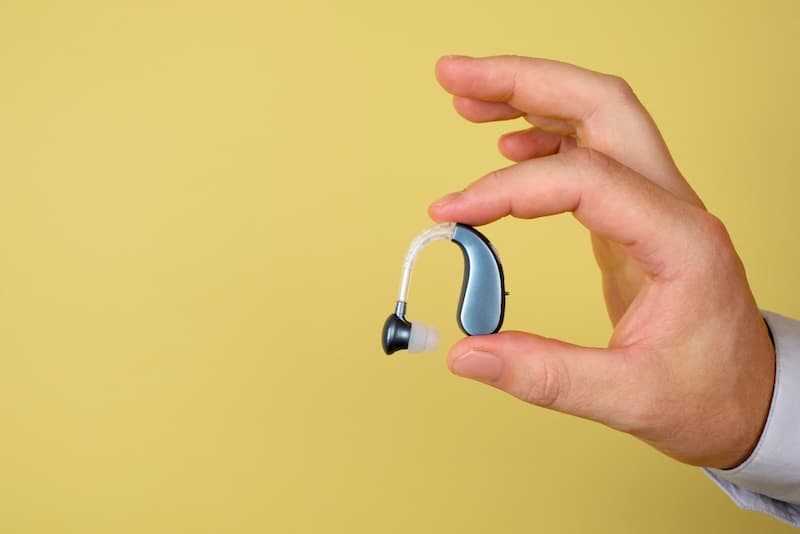
Here is what the 2015 review found across the published cases. Treat these as rough signals from small numbers, not success rates:
| Approach | What the published cases show |
|---|---|
| Treating hearing loss (hearing aid changes, earwax removal, ear surgery) | Improvement in 12 reported cases, half of them complete. Whether hearing aid changes helped was often not recorded. |
| Stopping or switching a drug that caused it | The best results of any group, when a medication or alcohol was clearly the cause |
| Acetylcholinesterase inhibitors | Complete response in 5 of 7 people with hearing loss, too few to draw firm conclusions |
| Antidepressants | Complete response in 6 of 19 people with hearing loss |
| Antiepileptics | Complete response in 6 of 27 people with hearing loss |
| Antipsychotics | Complete response in 6 of 31 people with hearing loss, with more side effects |
| No treatment at all | Faded or stopped on its own in 42 of 276 cases |
The authors suggested acetylcholinesterase inhibitors as a possible first medication for people with hearing loss, and found that antidepressants and antiepileptics had better response rates and fewer side effects than antipsychotics. Any of these is a decision to make with a doctor who knows your full history, not something to try on your own.
Living with the music day to day
For many people the music does not disappear completely, so coping strategies matter. The honest picture from the 2026 clinic study is that self-help gives relief but rarely a cure. About one in five people found that playing real music or other sounds helped for a while, a quarter said humming or singing along made it more bearable, and distraction and conversation also helped some. None found anything that silenced it for good.
Those are modest numbers, but they point in a useful direction:
- Give your ears something real to hear. For some people, real music, the radio or a podcast pushes the phantom music into the background for a while. Gentle background sound works on the same principle as white noise for tinnitus, and a nature sound session is an easy way to try it in a quiet room.
- Notice your triggers. If tiredness brings it on, as it did for a third of people in the implant study, that is worth knowing. A simple log of when the music appears and how loud it feels, like the one in our guide to tracking tinnitus triggers, can reveal a pattern you would otherwise miss.
- Stay connected. Social isolation is one of the factors associated with musical hallucination. Whether more company reduces the music is not proven, but time with other people adds real sound to your day, and that rarely hurts.
The worry around the music can be harder than the music itself. Wondering whether it means dementia or mental illness keeps your attention locked onto every note. If that is where you are, the skills in staying mentally strong with tinnitus apply here too. Cognitive behavioral therapy is a well-established approach for tinnitus distress. For musical ear syndrome itself, only isolated cases have been described, but the tools for loosening the grip of an unwanted sound carry over.
It also helps to tell the people around you. Saying you hear music that is not there can feel risky, but a clear explanation gives the people close to you a way to understand what you are dealing with. Our guide on how to explain tinnitus to others offers language you can adapt.
Conclusion: a real phenomenon with a usual explanation
Hearing music that is not there is one of the stranger things a brain can do, and it is natural to fear the worst. The research points somewhere much more ordinary. Most of the time it is your auditory system reacting to reduced input from the ear, not a sign that you are losing touch with reality.
The practical path is short. Get your hearing tested, mention the music to your doctor, and review any recent medication changes. If the music arrives alongside sudden hearing loss or new neurological symptoms, seek care the same day. Otherwise, an appointment with someone who knows how audiologists diagnose and treat tinnitus is a sensible place to start.
From there, better hearing, real sound in your environment and a little patience go a long way. For some people the music fades. For others it becomes background, the way tinnitus often does. Either way, you do not have to keep it to yourself.
Frequently Asked Questions
Why do I hear music when nothing is playing?
The most common reason is hearing loss. When the ear sends less sound to the brain, the auditory areas can become overactive and produce music of their own, usually familiar songs or hymns. This is called musical ear syndrome or musical hallucination. Less often it is linked to a medication, a neurological condition or a psychiatric illness, so it is worth getting your hearing tested and mentioning it to a doctor.
Is musical ear syndrome a mental illness?
Usually not. In a review of 276 published cases, about 60 percent of people had hearing impairment, and a review of the research found that serious brain or psychiatric causes are absent in most cases. It can occur alongside psychiatric conditions, which is one reason to mention it to a doctor, but hearing music on its own is not a sign that you are losing your mind.
Can hearing aids stop musical ear syndrome?
Sometimes. Improving hearing is the recommended first step once other causes have been ruled out, and published cases describe the music fading after hearing aid adjustments, earwax removal or ear surgery. It does not work for everyone: in a large study of cochlear implant users, some first noticed the music after their implant was fitted. An audiologist can tell you how much your hearing could be improved.
Does musical ear syndrome go away?
It can. In a review of 276 published cases, the music faded or stopped without any treatment in 42 of them, and others improved once the underlying cause was treated. For some people it lasts for years, and in a 2026 specialist clinic study most had no lasting way to switch it off. Treating hearing loss and avoiding known triggers such as tiredness can make it easier to live with.
Is musical ear syndrome the same as tinnitus?
They are related but different. Tinnitus is a simple sound such as ringing, hissing or buzzing, while musical ear syndrome is structured sound with melody and rhythm. Both are produced by the auditory system without an outside source, both are tied to hearing loss, and many people have both. In one 2026 clinic study, 40 percent of people with musical hallucinations also had troublesome tinnitus.
References
- Is musical hallucination an otological phenomenon? A review of the literature - Cope and Baguley, Clinical Otolaryngology (2009)
- Musical hallucinations: review of treatment effects - Coebergh et al., Frontiers in Psychology (2015)
- Auditory hallucinations in adults with hearing impairment: a large prevalence study - Linszen et al., Psychological Medicine (2019)
- Musical Ear Syndrome: Prevalence and characteristics in cochlear implant bearers - Duchêne et al., European Annals of Otorhinolaryngology, Head and Neck Diseases (2021)
- Detailed clinical characteristics of musical hallucinations in 81 patients - Kerklaan et al., Journal of Neurology (2026)
 Written by