Did Beethoven Have Tinnitus?
October 15, 2026
In the summer of 1801, a thirty year old composer at the height of his fame wrote to a childhood friend and admitted something he had hidden from almost everyone. It was not only that he was going deaf. It was the noise.
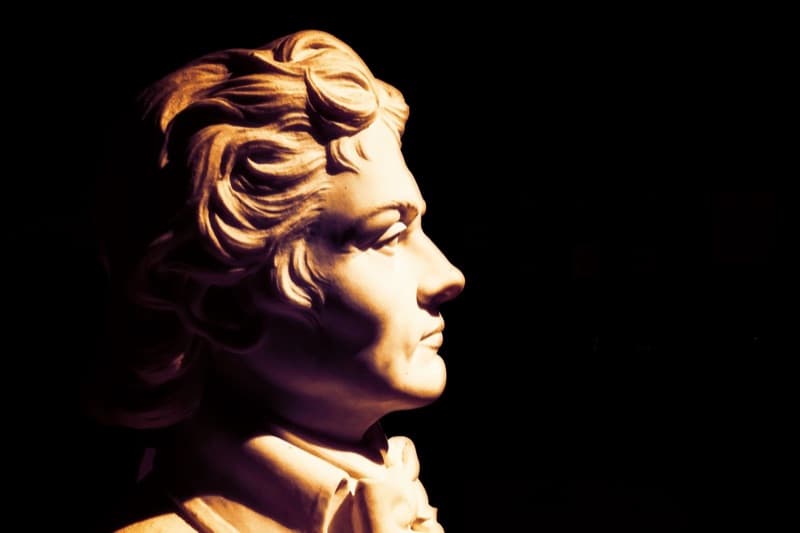
Did Beethoven have tinnitus?
Yes. In a letter dated 29 June 1801, Ludwig van Beethoven told his friend Franz Wegeler that his ears were "buzzing and ringing perpetually, day and night." That is a plain description of tinnitus, written when he was 30, about three years after his hearing began to fail and long before the near total deafness of his later life.
What makes the letter remarkable is how modern it sounds. Strip out the 1801 phrasing and it could be a message posted on a forum tonight: the sound that never stops, the doctors who try one remedy after another, the fear of anyone finding out. If you are new to the condition, what tinnitus actually is is a good place to start, but you do not need a definition to recognise Beethoven's.
This article is adapted from the first chapter of our audiobook, Shut Up, Tinnitus. It covers what Beethoven actually wrote, what his doctors tried, why a retreat to the quiet countryside did not bring the recovery he hoped for, and what an experiment in a soundproof room revealed about the sound he was hearing, 150 years later.
The letter to Wegeler
Franz Gerhard Wegeler was a physician who had known Beethoven since they were boys in Bonn. The letter, which survives in Beethoven's own hand at the Beethoven-Haus in Bonn, is the first in which Beethoven tells him about his hearing. He asks Wegeler to keep it in the strictest confidence.
The picture he paints, in the 1866 English translation by Lady Wallace, is detailed:
- His hearing "during the last three years has become gradually worse."
- His ears are "buzzing and ringing perpetually, day and night."
- For nearly two years he has avoided company, "because I find it impossible to say to people, I am deaf!"
- At the theatre he has to lean right up against the orchestra to follow the actors, and from a little way off he hears "none of the high notes of instruments or singers."
- In conversation he can "distinguish the tones, but not the words," yet he finds it "intolerable if any one shouts" at him.
Then comes the line that explains why he kept all of this secret: "In any other profession this might be more tolerable, but in mine such a condition is truly frightful." He was a pianist and composer whose reputation rested on his ears, and he was afraid of what his rivals would say.
Read today, the pattern will feel familiar to a lot of people with tinnitus and hearing loss: the high notes fade first, speech becomes harder to follow than music, and loud voices become uncomfortable rather than clearer. That last complaint is common with hearing loss, and in stronger forms it overlaps with what is now called hyperacusis, although nobody can diagnose a man from a letter written 225 years ago.
What his doctors tried
The same letter is a short catalogue of early nineteenth century ear medicine. Beethoven describes each treatment and how it went:
| Treatment | Prescribed by | Beethoven's verdict |
|---|---|---|
| Oil of almonds for the ears, tonics for digestion | Johann Peter Frank | "These did me no good whatever" |
| Cold baths | An unnamed doctor | Dismissed, he calls the doctor an ass |
| Tepid baths in the Danube | A second doctor, then Gerhard Vering | Digestion improved, hearing "rather got worse" |
| A lotion for the ears | Gerhard Vering | Felt stronger overall, ears still ringing |
Beethoven himself believed the root cause was his digestion, which had troubled him for years. Modern historians and doctors have offered many other explanations since, and none has been confirmed. The cause of his deafness is still debated.
November 1801: the ringing eases, the hearing does not
Later that year, on 16 November 1801, Beethoven wrote to Wegeler again. Vering now had him wearing blisters made from tree bark on both arms, a painful remedy that cost him the free use of his arms for a couple of days at a time.
The update is mixed. "The ringing and buzzing in my ears have certainly rather decreased, particularly in the left ear, in which the malady first commenced," he writes, "but my hearing is not at all improved; in fact I fear that it is become rather worse."
It is a small detail, but an interesting one. In his own account the ringing and the hearing loss did not move in lockstep. The noise eased while his hearing kept sliding. Anyone who has watched their own tinnitus rise and fall from week to week, and wondered whether tinnitus ever goes away, will recognise that unevenness.
Heiligenstadt: looking for quiet
In 1802 Beethoven spent about six months in Heiligenstadt, then a village outside Vienna. In his own words, his "intelligent physician recommended me to spare my hearing as much as possible." The plan was rest, distance from the city and quiet.
It did not deliver the recovery he hoped for. On 6 October 1802, still in Heiligenstadt, he wrote a long letter to his brothers Carl and Johann that is now known as the Heiligenstadt Testament. He never sent it. It was found among his papers after he died in 1827.
The letter is about deafness and isolation more than ringing. He describes the humiliation of standing beside someone who could hear a distant flute or a shepherd singing while he heard nothing. Such moments, he writes, "brought me to the verge of desperation, and wellnigh caused me to put an end to my life." What stopped him was his work: "Art! art alone, deterred me."
Two honest caveats belong here. The Testament does not say the buzzing got louder in the countryside, so there is no evidence that the quiet made his tinnitus worse. And his despair had many sources, above all a hearing loss that was ending the career he had built. What the document does show is that rest and silence, the best advice of his age, did not bring his hearing back.
Advice has changed since. Many people with tinnitus find the sound most intrusive in a silent room, which is why clinicians now tend to recommend gentle background sound rather than retreat into quiet. Our guide on whether silence can make tinnitus worse explains why.
If ringing ears or hearing loss ever leave you feeling the way Beethoven did in 1802, please do not carry it alone. Talk to your doctor or a mental health professional, or contact a crisis line in your country. The emotional side of tinnitus is real and treatable, and our article on tinnitus and mental health covers where to start.
What a soundproof room revealed in 1953
Nobody in Beethoven's time could have explained the sound he lived with. One of the most useful clues arrived 150 years later, from an experiment so simple it is almost rude.
In 1953 two researchers, Morris Heller and Moe Bergman, tested an assumption almost everyone held: that tinnitus is something broken ears have and healthy ears do not. They took 80 adults with normal hearing who did not report tinnitus and placed them, one at a time, in a soundproof chamber. 94 percent of them heard tinnitus.
A result that strange invites suspicion. Maybe people in a strange room, asked what they can hear, simply imagine something. In 2008 an Italian team led by Luca Del Bo tested exactly that, 55 years after the original study:
| Study | Participants | Setting | Heard a sound |
|---|---|---|---|
| Heller and Bergman, 1953 | 80 adults with normal hearing | Soundproof chamber | 94 percent |
| Del Bo et al., 2008, empty room | 53 young adults with normal hearing | Anechoic chamber, 4 minutes | 83 percent |
| Del Bo et al., 2008, dummy speaker | Same 53 participants | Same chamber with a loudspeaker connected to nothing | 92 percent |
The dummy loudspeaker nudged the number up, so suggestion did play a part. But look at the floor rather than the ceiling. With nothing in the room to suggest anything, 83 percent still heard a sound. The authors concluded that tinnitus-like sounds emerge in people with normal hearing in silence, and that suggestion plays only a minor role.
In other words, the raw material of the sound Beethoven described is not unusual. Most healthy auditory systems produce something like it. What usually happens is that the brain filters it out before it reaches awareness, the same way you stop noticing the hum of a fridge.
What this means if you have tinnitus
It would be wrong to say that chronic tinnitus is the same thing the volunteers heard after a few minutes in a chamber. Persistent tinnitus is usually louder, it does not switch off when you walk out of a quiet room, and it is often tied to hearing loss and to changes in how the brain processes sound. Beethoven's clearly was.
But the experiments do change how the problem looks. The question is less "what is this strange new sound?" and more "why has my brain stopped filtering out something it used to ignore?" That reframing sits at the heart of the most practical approaches to living with tinnitus:
- Avoid total silence. Low, steady background sound gives your hearing something else to process. White noise, rain or a fan at a comfortable volume all work, especially at bedtime.
- Protect your sleep. Nights are when silence is hardest to escape. Our guide to tinnitus and sleep covers what helps.
- Work on the attention, not just the sound. Cognitive behavioral therapy has the strongest evidence of any approach for reducing how much tinnitus bothers people, even though it does not remove the sound.
- Get new tinnitus checked. Ringing in one ear only, tinnitus that pulses with your heartbeat, or tinnitus that arrives with a sudden drop in hearing should be seen by a doctor promptly. Sudden hearing loss is treated as urgent.

Beethoven is not the only famous name on the list
Beethoven is the most famous historical case, but he has plenty of company. From musicians exposed to loud stages to actors and athletes, our roundup of celebrities with tinnitus shows how ordinary the condition is, even among people whose lives look extraordinary. The longer view is in tinnitus through history, and if you are curious about another famous case, we looked at whether Van Gogh had tinnitus too, where the evidence is far thinner.
Conclusion: the sound he carried with him
Beethoven did have tinnitus, and he described it in words that would fit any modern case: ringing and buzzing, day and night, alongside a hearing loss that frightened him more than anything else in his life. He tried every remedy his doctors offered, and he went looking for quiet in a village outside Vienna. The quiet did not cure him, and what he wrote there is one of the most painful documents in music history.
He also kept composing, for another quarter century, through hearing loss far worse than most of us will ever face. And thanks to two researchers in a soundproof room, we now understand something he could not: the sound he was hearing was not a foreign invader. It was built from something nearly every healthy auditory system produces in silence. That knowledge does not make the ringing disappear, but it changes what you are fighting, and that is where real relief starts.
Shut Up, Tinnitus
Chapter 1: Beethoven's Letter from Vienna. Beethoven went to a quiet village to escape a sound he was carrying with him. Here is why that could never work.


Frequently Asked Questions
Did Beethoven have tinnitus?
Yes. In a letter to his friend Franz Wegeler dated 29 June 1801, Beethoven wrote that his ears were buzzing and ringing perpetually, day and night. He was 30, his hearing had been getting worse for about three years, and he had told almost nobody. In a second letter that November he reported the ringing had eased a little, especially in his left ear, while his hearing had not improved.
When did Beethoven start losing his hearing?
By his own account, in the late 1790s. His June 1801 letter to Wegeler says his hearing had grown gradually worse over the previous three years. The Heiligenstadt Testament of October 1802 describes an incurable condition that had attacked him six years earlier. His hearing kept declining over the following years until he was almost completely deaf.
What is the Heiligenstadt Testament?
It is a letter Beethoven wrote to his brothers Carl and Johann on 6 October 1802, while staying in the village of Heiligenstadt outside Vienna. He describes the isolation his deafness caused, admits he came close to ending his life, and says his art held him back. He never sent it. It was found among his papers after his death in 1827.
What caused Beethoven to go deaf?
Nobody knows for certain. Beethoven himself blamed his long-running digestive problems, and historians and doctors have proposed many explanations since. None has been confirmed, and the cause of his hearing loss is still debated. What his letters do record clearly is the sequence: ringing and buzzing, trouble hearing high notes and soft speech, and a hearing loss that worsened over many years.
Can people with normal hearing hear tinnitus in silence?
Most can. In a 1953 study, 94 percent of 80 adults with normal hearing reported tinnitus after sitting in a soundproof chamber. A 2008 replication found 83 percent of 53 young adults heard at least one sound in an empty anechoic chamber, rising to 92 percent when a disconnected loudspeaker was placed in the room, which suggests suggestion plays only a small role.
References
- Letter to Franz Gerhard Wegeler, Vienna, 29 June 1801 (autograph, Sammlung Wegeler W 17) - Beethoven-Haus Bonn
- Beethoven's Letters 1790-1826, Volume 1, translated by Lady Wallace - Project Gutenberg
- Tinnitus aurium in normally hearing persons (Heller and Bergman, 1953) - Annals of Otology, Rhinology and Laryngology, via PubMed
- Tinnitus aurium in persons with normal hearing: 55 years later (Del Bo et al., 2008) - Otolaryngology-Head and Neck Surgery, via PubMed
- Tinnitus in normally hearing patients: clinical aspects and repercussions - Brazilian Journal of Otorhinolaryngology, via PubMed Central
 Written by